
Performing Competency
The AHM Coalition and the theater of maintaining the status quo


In October, the AHM Coalition held what they called a “frank discussion on securing the future of acupuncture in the U.S.” The closing remarks announced a March town hall.
Last night was that town hall. They’re going to do it every month. One CEU per session.
A monthly meeting where the key takeaways slide never mentions student outcomes, debt load, or graduate earnings isn’t accountability. It’s a calendar invitation to watch the same performance again.
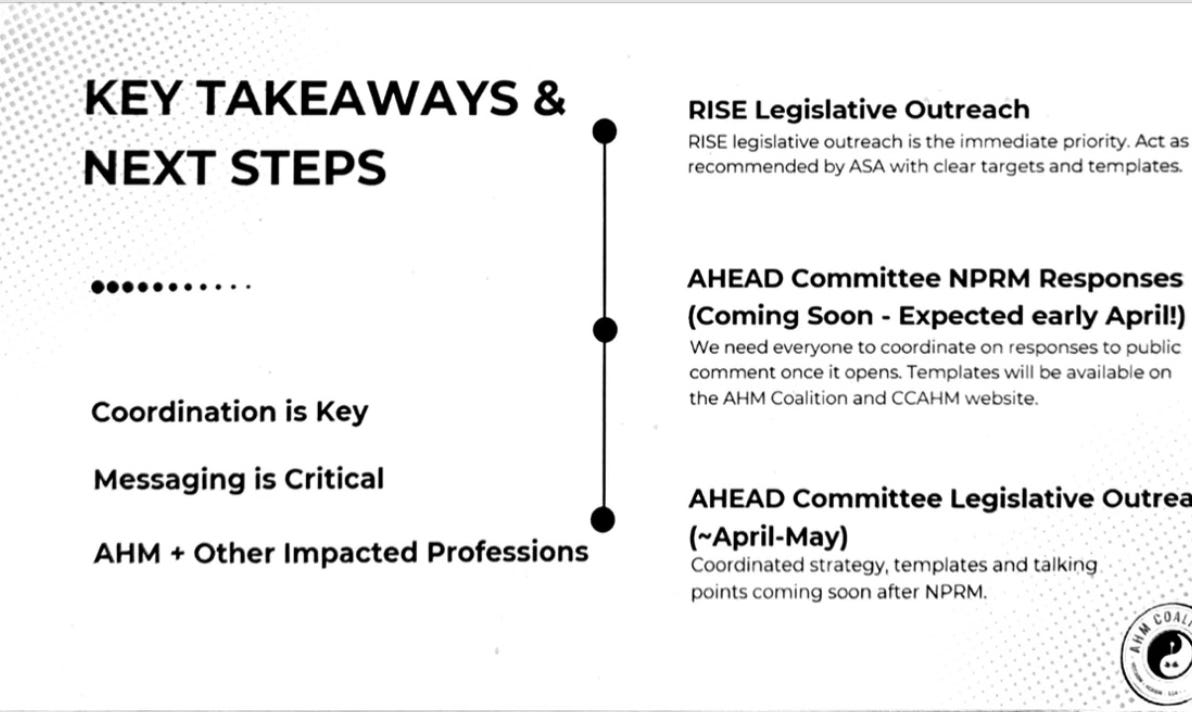
Here’s what was on that slide: Coordination is Key. Messaging is Critical. Act as recommended by AHM.
Here’s what wasn’t: student outcomes. Workforce access. Debt relief. Any action item that would require the institutions themselves to change.
Forgive me if my frustration is showing. I’m a licensed acupuncturist serving mostly Medicaid patients in Portland. I help run primary care clinics in Nepal remotely each week. I don’t charge for this Substack because I want it accessible to the students and graduates of programs that have harmed them. I’m a mom and a small business owner and none of my work in trying to improve these structures that are harming our students, graduates and colleagues pays me anything.
I say this not for sympathy but for context: I was in that room last night because someone has to be. What I watched was paid institutional staff performing the work of reform without doing any of it, and volunteer practitioners from ASA, people who are often as harmed as the rest of us, being handed the script and asked to run it.
The same argument as always
The income argument they keep making deserves a direct response, because they made it again last night.
Their claim is that self-employed people’s gross income looks artificially low because expenses are deducted, so the earnings metrics undercount acupuncturists’ real income. In other words, they’re saying the data makes acupuncturists look poorer than they are.
Net income after expenses is the correct measure of what someone actually earns and can use to repay loans. Gross revenue is not income. The Department of Education earnings metrics are measuring what graduates actually take home, which is the only number that matters for debt repayment analysis. Counting gross revenue would be like saying a restaurant owner who grosses $500k but nets $30k is doing fine.
Before my yurt, I rented a two-room clinic in Portland and it cost me $2,000 a month. That’s $24,000 a year I have to earn before I pay myself anything. And, of course there are other expenses. When my business grosses six figures, that is not my adjusted gross income. Not understanding that distinction in our early years (because these schools are so bad at teaching business) is exactly what allows people to prey on new graduates with promises of six-figure incomes. And, it’s the same misunderstanding that allows these institutions to prey on us with accusations that these metrics should not be applied to us.
To claim that expenses should be counted as self-employment income to improve ACAHM’s outcomes data is not a frank conversation. It is victim blaming. And they have been making this argument publicly for at least twelve years. They’ve had all this time to commission better data collection if that was their real concern. They haven’t. That’s the tell. If the measurement problem were genuine and they were acting in good faith, they’d have funded longitudinal alumni surveys by now. The fact that they keep raising the measurement objection without ever solving it tells you it’s not a sincere methodological concern. It’s a stall.
“We’re all in this together”
They also said we’re in the same boat as nurses, physical therapists, and occupational therapists, that we’re all fighting this fight together against federal overreach.
We are not in the same boat.
Nurses can be trained at the associate’s and bachelor’s level. They have jobs waiting. Physical therapists have hospital systems, clinics, and schools hiring them. Even in PT, where there are actual jobs waiting on the other side, the profession spent decades debating whether the entry-level doctoral requirement was justified, and critics argued the curriculum didn’t actually change, just the credential.(Rothstein 1998; Moffat 1994) These professions have employers at the table, articulation agreements, integration with the broader healthcare workforce.
You cannot say in one breath that acupuncturists aren’t employed and in the next that we are just like other allied health professionals. You can’t claim solidarity with professions you have never actually joined or worked with.
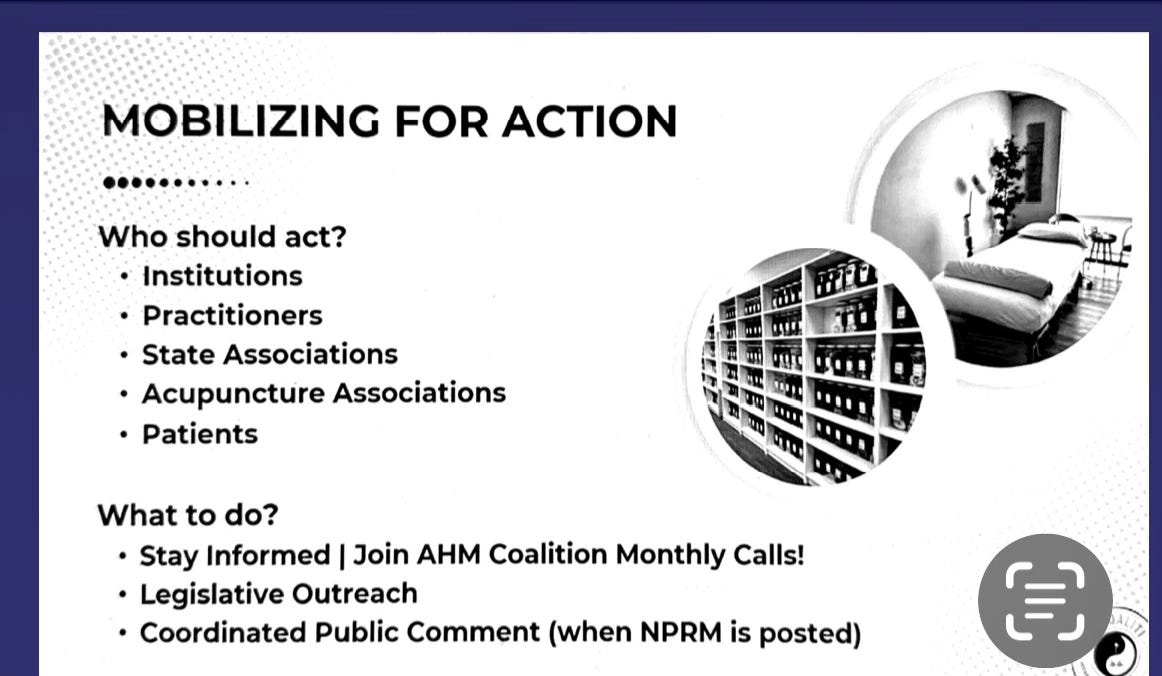
Mobilizing for action
The coalition’s call to action, their “Mobilizing for Action” slide, lists practitioners and patients as the people who should act. Act how? Legislative outreach. Coordinated public comment. Templates from ASA.
The programs that charged us $100,000+ should not have to answer for our outcomes. We should answer for theirs.
That is what those slides say. I didn’t write it. They did.
Here’s me letting out a long, disappointed sigh. Let’s sit with that for a minute.
Paid to Solve It
I understand that many of the practitioners involved with ASA are volunteers, and that as graduates of these same programs, they are often equally harmed. And it can be hard to wade through the fog that the institution creates to protect the status quo. I have compassion for that.
But the paid staff in that room – and they were there – need to do better. They are being paid to manage this crisis and those funds are coming from dues/fees collected from schools, which collect tuition from students, who borrow it from the federal government and carry the debt for decades. That is the funding chain. And at the end of it, the call to action is: practitioners and patients should write letters so the schools and accreditor don’t have to answer for outcomes.
This can’t be about repairing the past yet. Right now we just need to focus on stopping the ongoing harm being inflicted on our students. We must get situated in the current data instead of saying it doesn’t exist. We must stop asking practitioners and patients to run interference for institutions that won’t reform themselves.
Disappointing indeed, but do we really expect the institutions to dissolve themselves and return to their juvenile stage to regrow a new form, like the immortal jellyfish? I jest because I see that as the only practical way forward- and it's the exact opposite of what most institutions live for (rigid structure, bureaucratic continuity). Expecting the people paid by those institutions to even consider dissolving parts of themselves seems unrealistic, even as it is clearly necessary to some degree, to avoid the inevitable complete collapse. Perhaps acupuncturists' innate lack of corporate experience (generally a good thing) has become a stumbling block to tactical moves that take all those organizational defensive postures into account?
This whole conundrum does resemble a larger process at play, which is the question of how humanity chooses to adapt to the reality of runaway global heating and climate wilding. Our bureaucratic inertia and vested interests are currently the death of us, literally. So I mirror your frustration and feel trapped in a very uncomfortable way- and this is a feeling that many people avoid at all (future) cost via the wonders of denial and blame shifting.
Digging deep at this moment to confront difficult realities seems to be going against the grain of a direct cultural complacency campaign. So the solutions must always be couched in terms of how much we will win, how much cultural recognition and acceptance sits at the end of the rainbow. That's all I can contribute now, as I agree with your analysis 100%, and also think that the only way to win against a slippery corporate entity is to become even more slippery to some degree.
That town hall was an absolute joke. If I was a director of a school I would be pissed. They literally said, “people are going to lose access to this medicine both practitioners and patients, the only people who will have access are those who can access private loans, or those in affluent neighborhoods” 🤯🤯🤯🤯