
Slide 21
98% of acupuncture schools are projected to fail based on the Earnings Premium Metric

Since 2023, I’ve been citing the debt-to-earnings (DTE) data that was published by the HEA Group. That data is incredibly important because when it is sorted by the DTE column, you can see that:
Out of 6300 graduate schools studied across the nation 6 of the top 10 worst performers for DTE are ACAHM-accredited [acupuncture] schools.
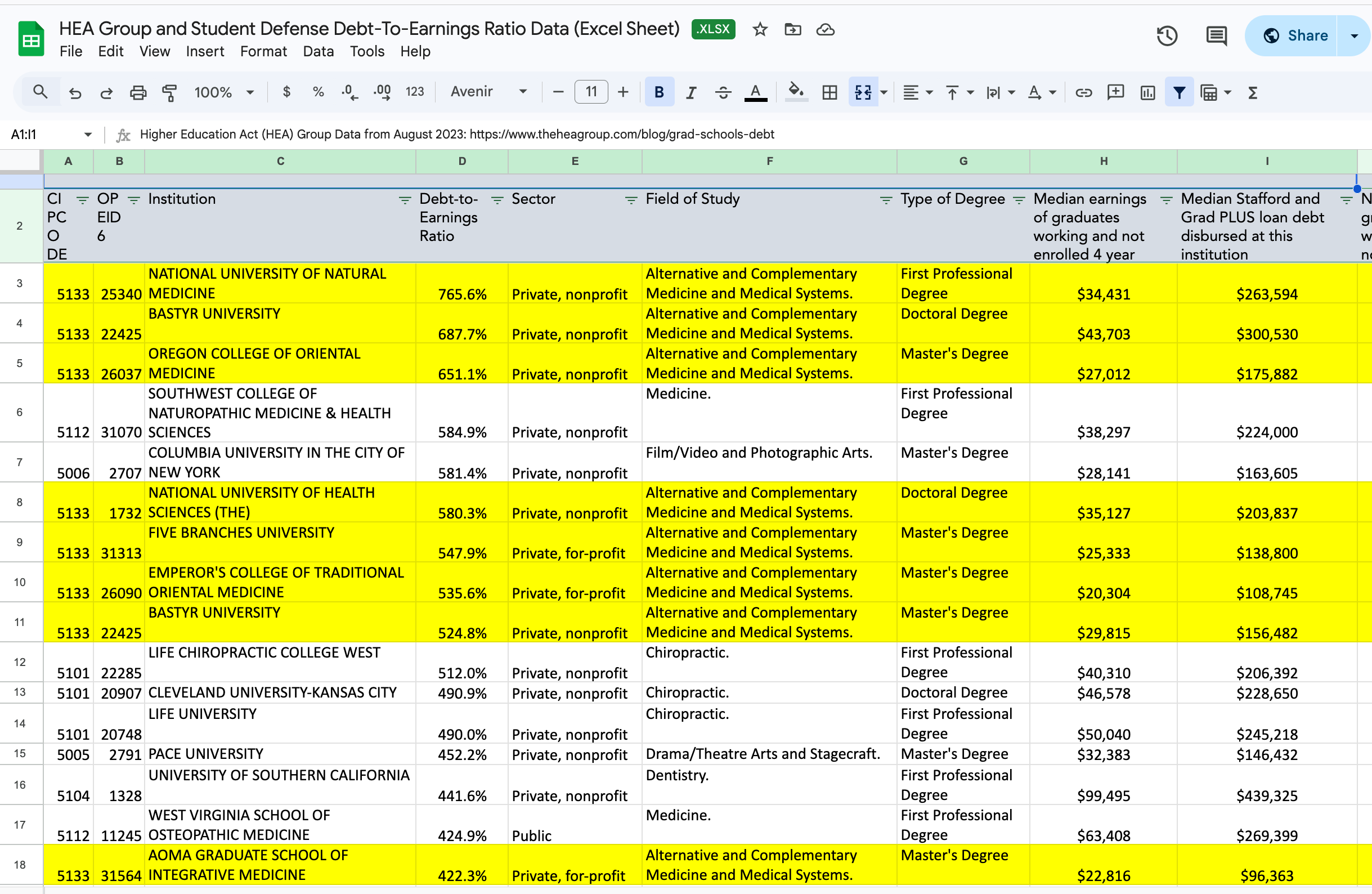
Even so, I hear a lot of people misquoting this data and saying the DTE ratio is what is going to trigger warnings from schools in 2027 and loss of financial aid in 2028.
What is being used is a different metric called the Earnings Premium Test. This was always coming, but the OBBBA and Biden Administration differed a bit on the inputs: high school diploma versus bachelors degree.
On January 5, 2026, the U.S. Department of Education’s Office of the Chief Economist presented “Estimated Impact of the Program Level Earnings Test and Changes to Gainful Employment,” a 22-slide deck that’s public and on ED’s website. It draws on IRS tax records, federal loan data, FAFSA, and IPEDS to project which program types are most likely to fail the federal earnings test when it goes live in 2027.
This isn’t a survey or a think tank report. It’s the federal government’s own economists building a picture of what grad school graduates make compared to what folks with a bachelors degree make.
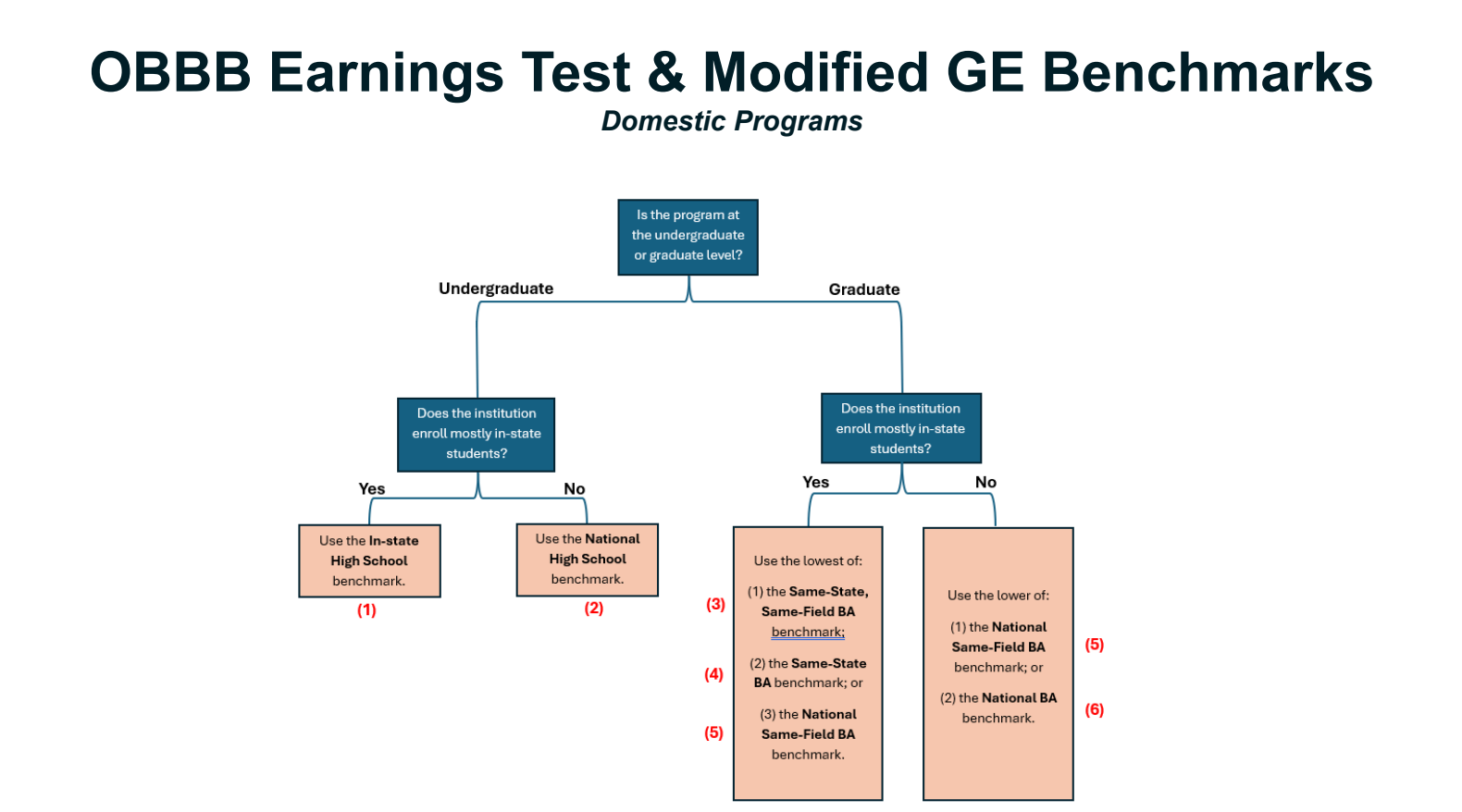
The earnings test is straightforward: if a master’s program leaves graduates worse off financially than if they’d stopped at a bachelor’s degree, the program fails. It’s not measuring clinical competence. It’s measuring whether the debt for an advanced degree is justified.
This preliminary data is organized at the 4-digit CIP code level: broad field categories. At 4 digits, every acupuncture program in the country is grouped into CIP 51.33: Alternative and Complementary Medicine and Medical Systems, alongside naturopathic medicine and other modalities.
When the actual test runs in 2027, it will use 6-digit codes, which separate out specific program types. That’s when acupuncture programs get measured on their own. The 6-digit code builds specificity in, like our ICD10 codes do: 51.3301 will be specific for “Acupuncture and Oriental Medicine.”
For the projections, the 4-digit data tells us how our entire category is performing.
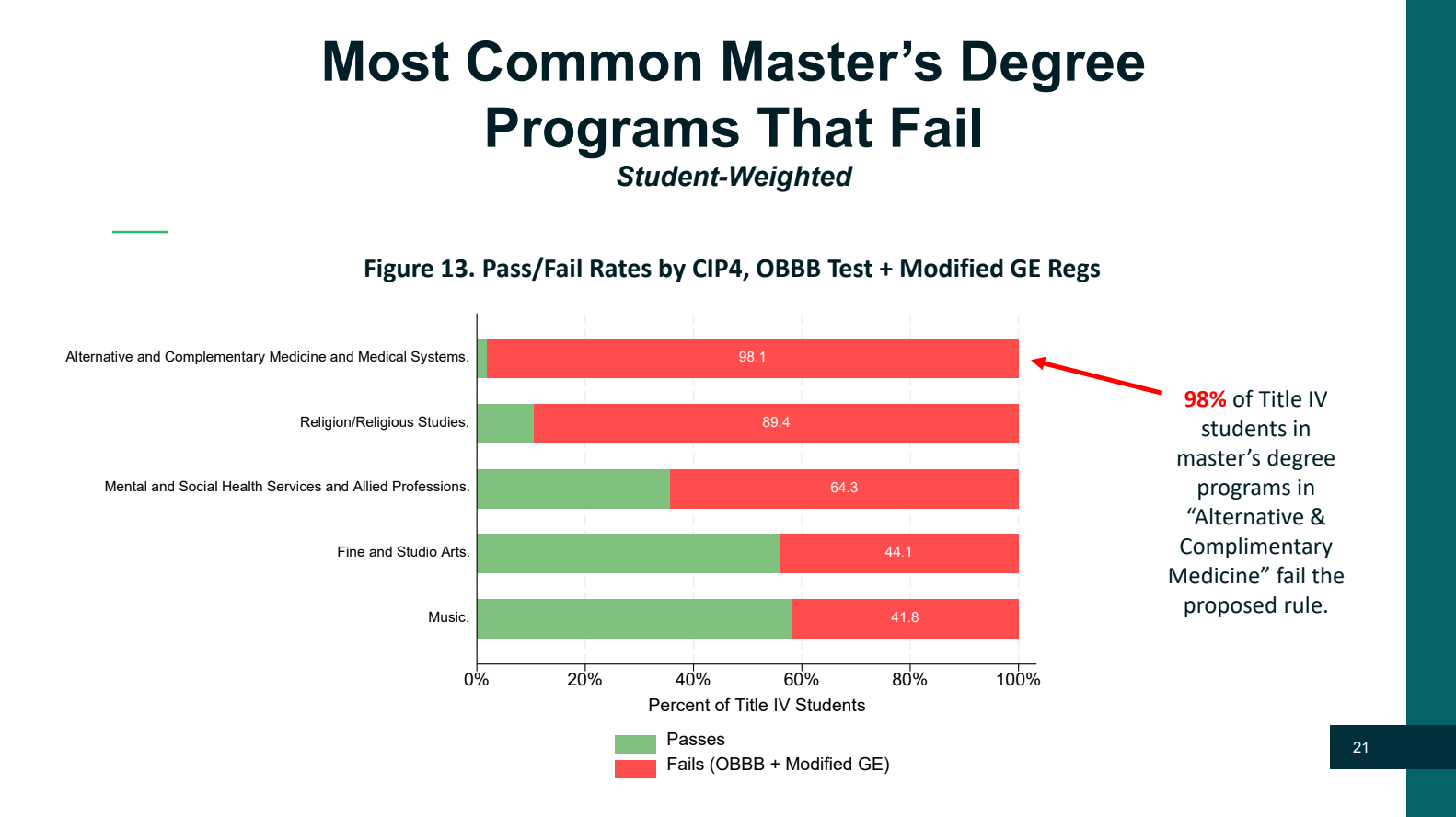
That brings us to slide 21.
It shows the most common master’s degree fields whose students are enrolled in failing programs. At the top of the chart, nearly solid red: Alternative and Complementary Medicine and Medical Systems: 98.1%
That means 98.1% of Title IV students in graduate programs in our category are in programs projected to fail the earnings test.
This is a projection, not a final determination: but it's the federal government's own economists doing the projecting.
Another acupuncturist told me that “this data is just loan reliance figures:” It isn’t. Loan reliance measures how many schools depend on federal aid. The Program Performance Data 2026 measures the ratio of what graduates earn to what they borrowed, using IRS income records.
The more substantive criticism is that the 4-digit data will look different at 6 digits. That’s true, and worth watching. But the direction is clear. The burden of proof is on anyone claiming acupuncture programs will look substantially better when disaggregated from CIP 4 to CIP 6.
Those of us working on diversifying and adding a state-regulated pathway to licensure understand the benefits of having a single, nationally vetted competency standard and exam system. We don’t discount that (and want to leave the current system intact as a pathway). But nobody at the national level has actually introduced any solution for substantially, and I mean SUBSTANTIALLY, lowering the cost of tuition so that our graduates aren’t saddled with debt.
But as you can see from this data, what’s even more important is that this is not a DTE metric. Reducing debt solves the debt-crisis problem, but it doesn’t solve this one. We need to be talking about bachelors and post-bac certificates if our graduates’ salaries are stagnating there.
If a graduate-level acupuncture program produces alumni who don’t earn more than folks with bachelors degrees, then we need to move away from requiring graduate degrees for entry-level practice.
(Please don’t conflate this statement and say I’m saying we shouldn’t have a nested degree pathway that can result in a Master’s or Doctoral degree, as so much of the rhetoric is doing).
Slide two one reality check!